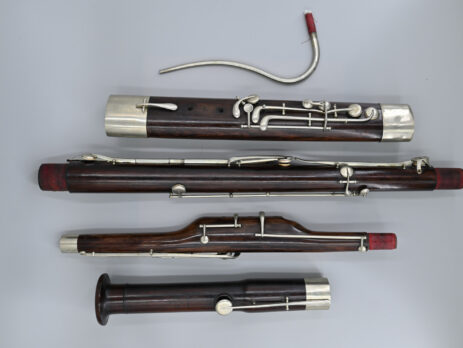
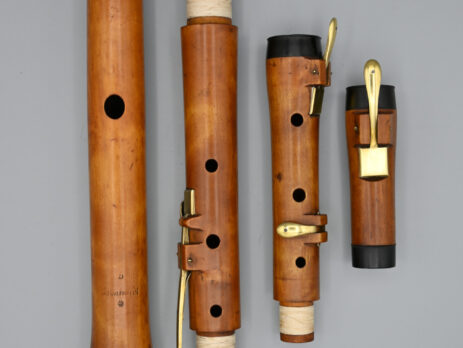
Thirteen-keyed B-flat clarinet by Giacinto RIVA

This 13-keyed B-flat clarinet is crafted in boxwood, with nickel silver rings and keys. The workmanship is of a very high level and the boxwood has a lovely, aged honey colour. It even has its original case! Giacinto Riva worked in San Giovanni in Persiceto in the province of Bologna, Italy...

Verdi contrabass trombone – DESIDERA E FIGLI

This large and quite outlandish instrument is known as a Verdi contrabass trombone. It is rarely seen by audiences nowadays, but maybe we can change that 😉. [Just making the photos was so much fun!] The Verdi contrabass trombone is a member of the trombone family and is the largest form...

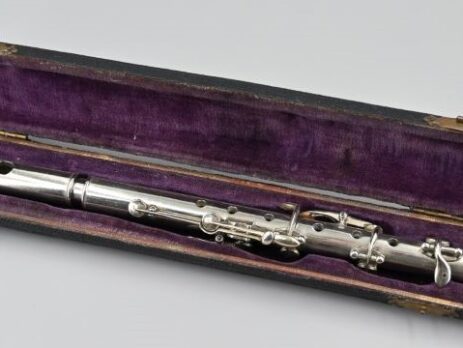
English flageolet-piccolo – George BUTLER

This rare Cocuswood English flageolet with alternative piccolo head joint was made by a company led by George BUTLER (1795-1870) – the head of a family of instrument makers that were producing and dealing in brass, woodwind and many other instruments in Dublin and in London between 1826 and 1927....

Five-keyed boxwood flute – LEONHARDT

Here is a five-keyed flute by LEONHARDT. Some initial research has led us to a flute made by the same maker at the Michaelstein Abbey collection in Germany. A boxwood clarinet by Leonhardt with the same stamp was also recently sold at auction in the UK. This instrument is crafted in...

Ten-keyed romantic flute – Stephan KOCH

This is a fabulous ten-keyed flute made in Vienna in 1851 at the workshop of the family of Stephan KOCH (1772-1828).  Stephan Koch made all kinds of woodwind instruments, including bassoons, csakans and clarinets in his workshop in Vienna. However, he is most known for his improvements to the design...

Seven-keyed cocuswood flute – MONZANI, Tebaldo

This is a nice and typical example of a Cocuswood flute made by the famous Italian-born, turned Englishman, Tebaldo MONZANI (1762-1839).  It is a three-piece construction. Two head joints are supplied, rather than just one head joint with a tuning slide.  [Tuning slides often cause cracking in the wood.] There...

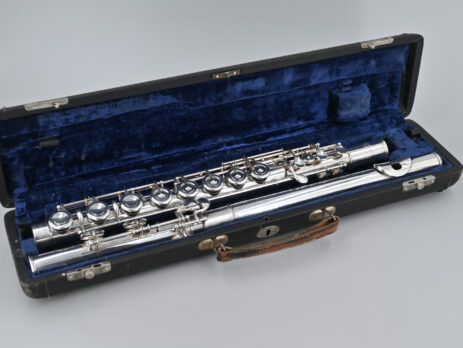
Reform flute – SCHWEDLER-KRUSPE

This reform flute was made by Carl KRUSPE Junior (1865-1929) when he was active in Leipzig, Germany, between 1893 and 1929. He was the eldest son of Friedrich Wilhelm KRUSPE (1838-1911) and successor of the Kruspe company, founded by his grandfather Carl KRUSPE Senior (1808-1885) in Erfurt.  The flute was...

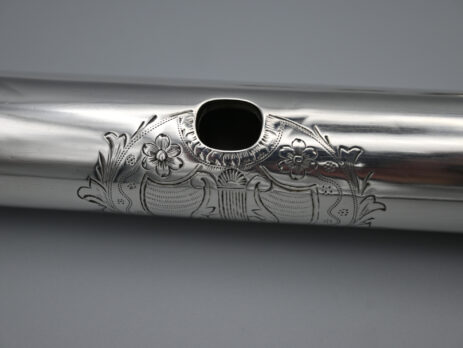
Conical ring-key flute – Julius Max BÜRGER

This sensational conical ring-key flute was fully restored by master woodwind instrument makers. The instrument is crafted in gorgeous Cocuswood with nickel/German silver ring keys and rings. It plays at a pitch of a=440Hz. Furthermore, it was supplied in a brand-new, leather-covered wooden case which was designed especially for this...

Flute – KRAUS, Anton

This spectacular, naturally figured, boxwood romantic flute was made by the woodwind and brass instrument maker, Anton KRAUS (1813-1901). Anton KRAUS was born in 1813 in Eger which was the German name for the town of Cheb in the Czech Republic. He started working for the bassoon maker Wenzel HORAK in...

Silent gravity metronome

This extremely rare silent gravity metronome in metal is signed on the front “PATENTED / BREVETE”. On the back it reads “DRP / 350358”. [D.R.P. - Deutsches Reichspatent]. The DRP, or German empire patent, was a patent, assigned from 1877 until 1945. This patent number was assigned in the year...