

B-flat bass flugelhorn – BÖHM, Elias
790,00 €
| Category | Other musical instruments |
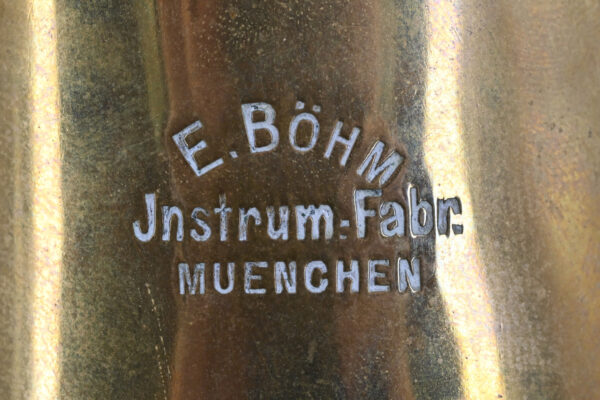
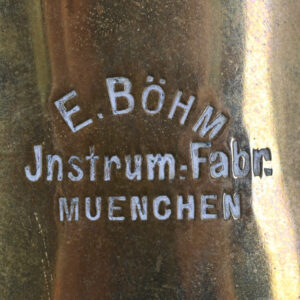
| Marks and inscriptions | E. BÖHM / Instrum. Fabr. / MUENCHEN |
| Period | 1830-1900 |
| Place of origin | Munich, Germany |
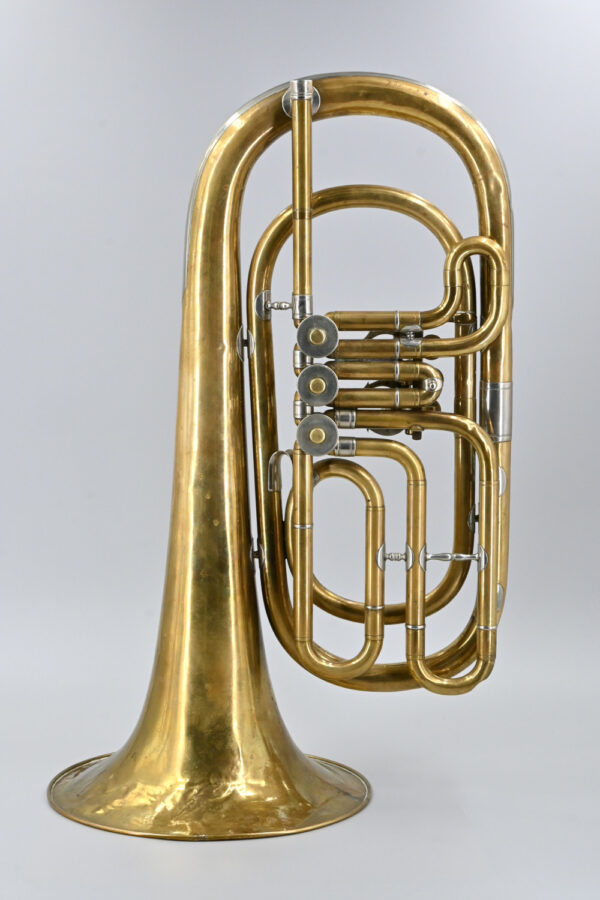
| Description | B-flat bass flugelhorn by Elias BÖHM |
| Materials | Brass |
| Dimensions | Height 520 mm Bell diameter 240 mm Weight 1752 g |
| Condition | Sold as is, for restoration |
| Price (€) | €790.00 |
| Ref | 1410 |
- Description
- Enquiry
Description
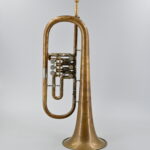
B-flat bass flugelhorn – BÖHM, Elias
This rotary-valve B-flat bass flugelhorn was created by the Munich-based brass instrument maker Elias BÖHM (1878-1960). Elias Böhm was born in Silberbach in the region of Graslitz (Kraslice), now in the Czech Republic.
There were two very important brass instrument workshops in Munich in the 1800s: the SAURLE family workshop and the Andreas BARTH (ca. 1797-1868) workshop. These workshops passed on their instrument-making knowledge to succeeding generations or to apprentices from outside. The literature confirms that when Johann Georg SAURLE (1799-1859) died, Georg LANG (1833-1907) took over, who was then succeed by our Elias Böhm. Elias married Antonie WENGLER in Berlin in 1902. He died in Neustadt, in the district of Marburg in Hessen in 1960.
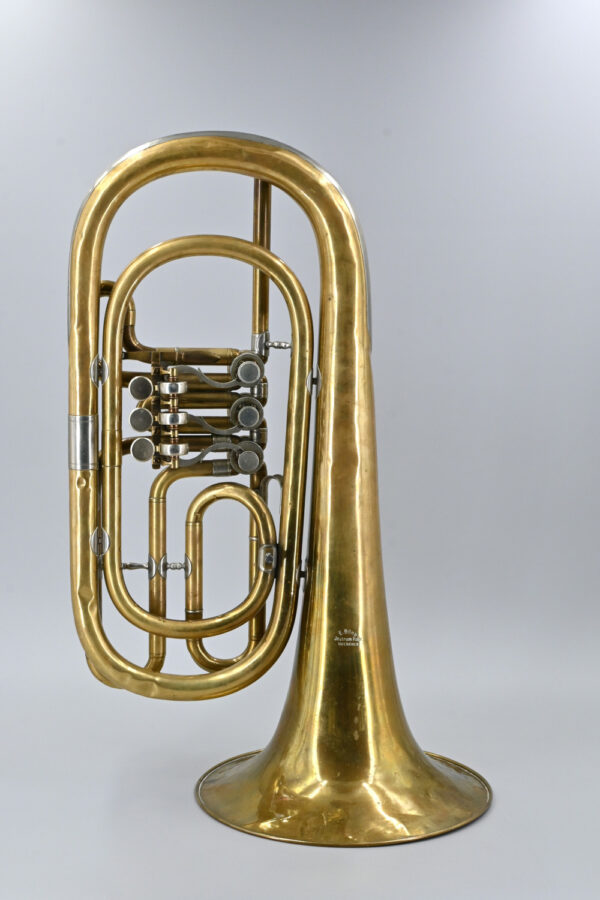
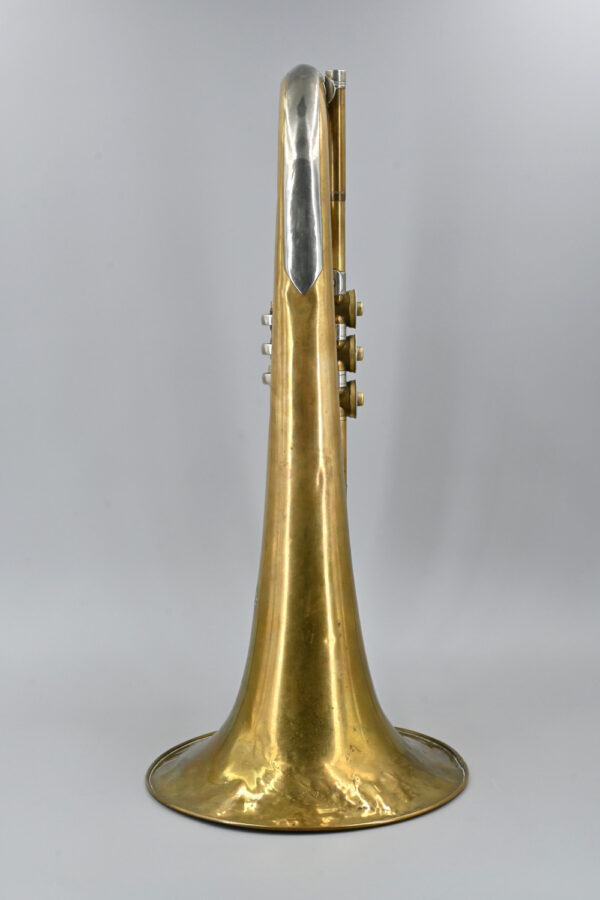
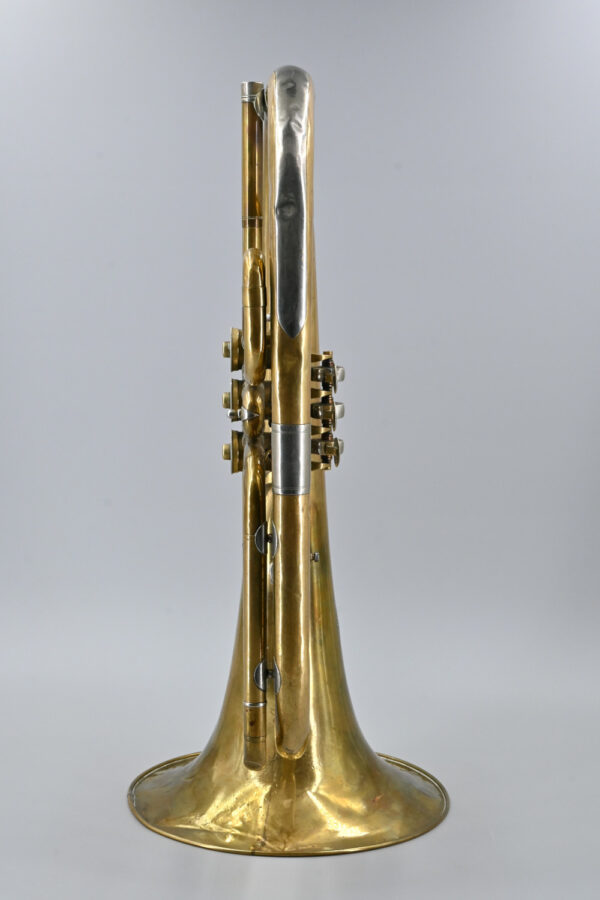
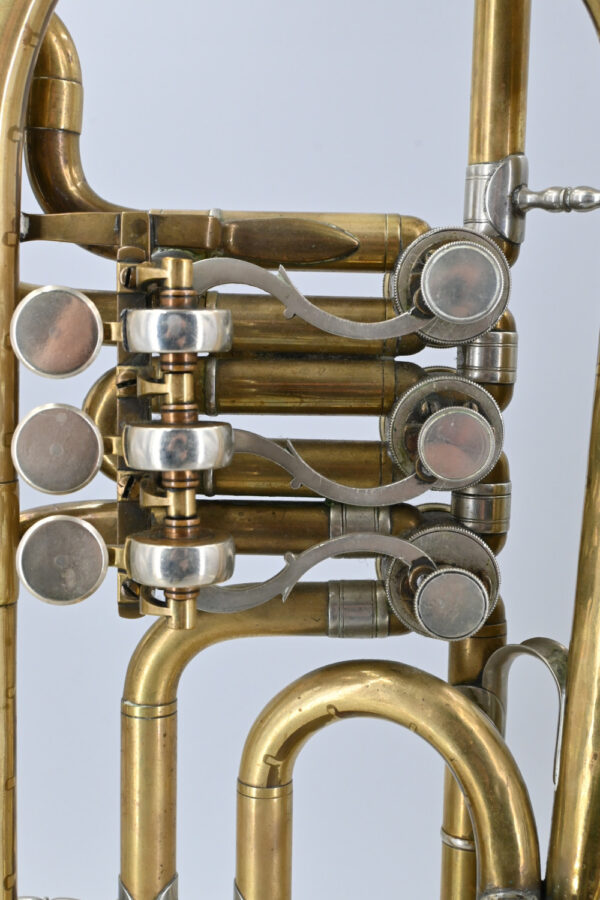
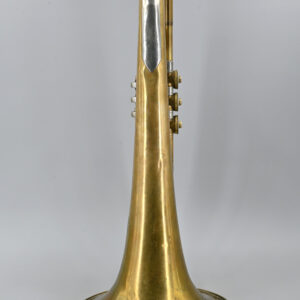
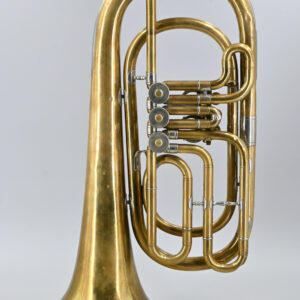
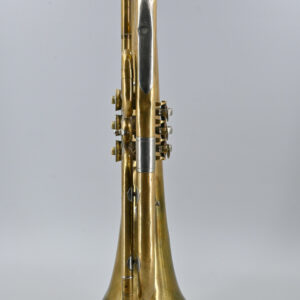
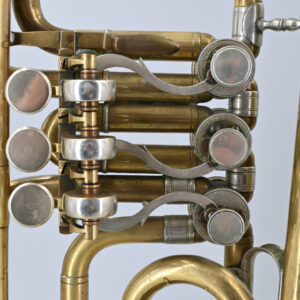
Built in the late 19th or early 20th century with a classic Central European Blasmusik (wind band) style, it features a compact, upright oval brass wrap and a nickel silver trim and protective bow guards. Instead of modern piston valves, it has three traditional clockwork-spring rotary valves.
It is played in a horizontal position – making it quite special. In traditional Bavarian brass bands, Munich makers built these compact, oval horns with narrower tubes for a brighter sound. Even though it is shaped like a small baritone or bass flugelhorn, a 1900 Munich shop would have simply called it a “bass trumpet” (Basstrompete) or a Tenorhorn. In the region of the town of Bad Tölz, near Munich, this instrument is called a “Tölzer-Schneck”, literally translating to “Tölz Snail” in Bavarian dialect.
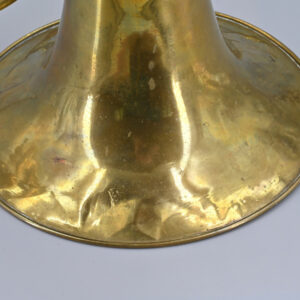
It does have some cosmetic wear. Apart from its patina, there is some surface tarnishing and minor scratches. There are visible knocks and small dents along the outer tubing bends, leadpipe and bell flare, as well as a couple of slight bends along the edge of the bell rim.
The instrument is sold as-is without a mouthpiece and has not been play-tested.
Our opinion
A wonderful collector’s piece, particularly appealing to enthusiasts of historic Bavarian Blasmusik heritage and early Munich brasswind makers.